Watchman does not use a seamlessly interconnected world. For a solo project, that production burden would be impractical. I chose a hub-and-spoke structure instead: the distance between bonfires and a hub that grows with the story carry the spatial character of the Soulslike format.
The hub: the center of the spoke structure
The game’s core is a special map—the hub, comparable to the Hunter’s Dream in Bloodborne. The player leaves it to enter each region, then returns to rest, level up, and forge equipment.
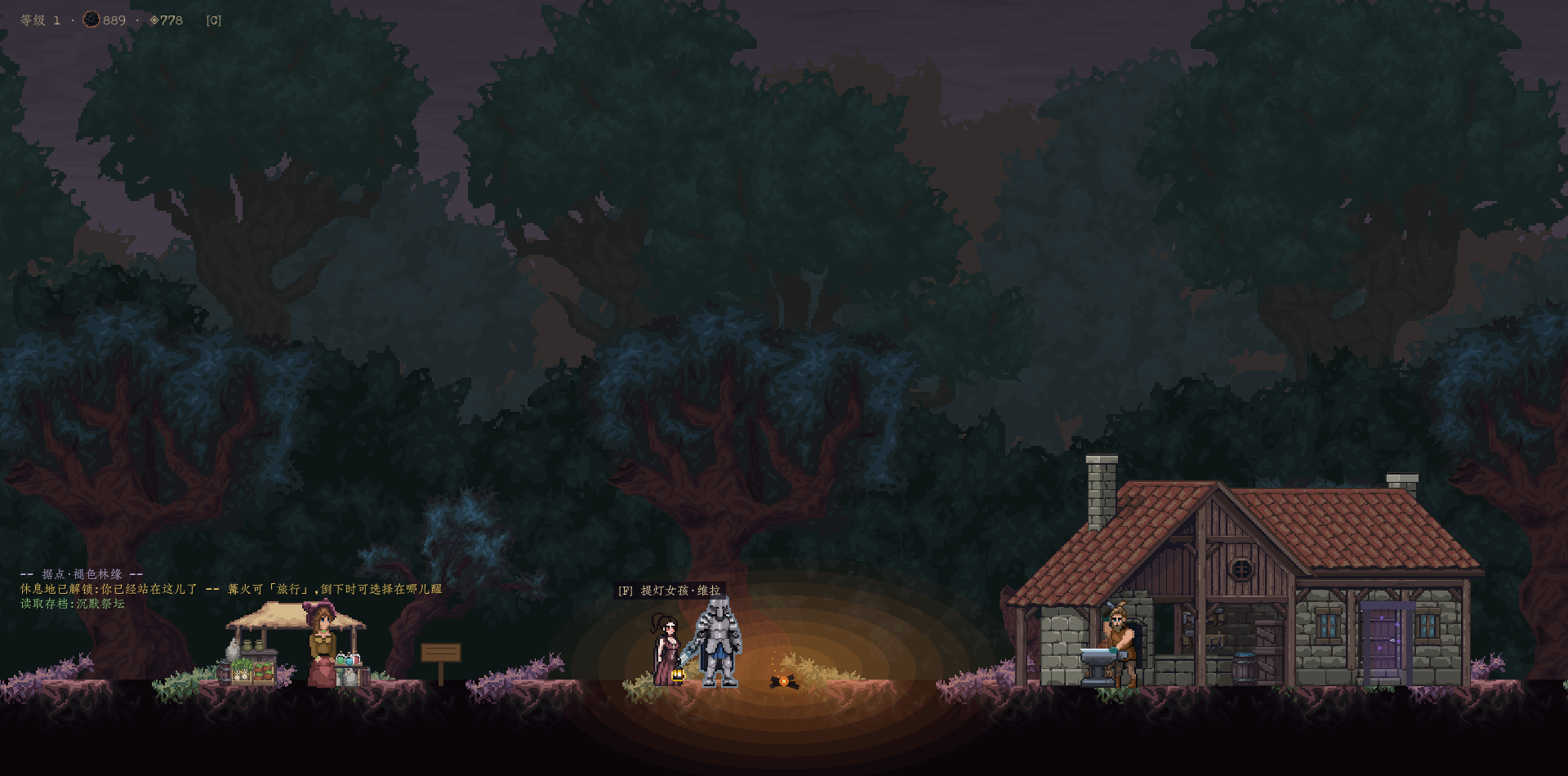
The hub grows with the story. It begins as a damaged house and a single forge fire. Each rescued NPC activates one station and one function: Vera handles leveling and naming, the smith handles forging, and the merchant handles trade. The screenshot above shows the completed state, with Vera beside the bonfire, the smith at the forge, and the merchant at her stall.
The implementation uses a deliberate simplification. The entire hub is built once, with every NPC station already placed and controlled by a visibility flag. There is no separate art transition from ruin to gradual reconstruction. Growth is expressed through state changes, avoiding repeated environment production.
Travel: every region transits through the hub
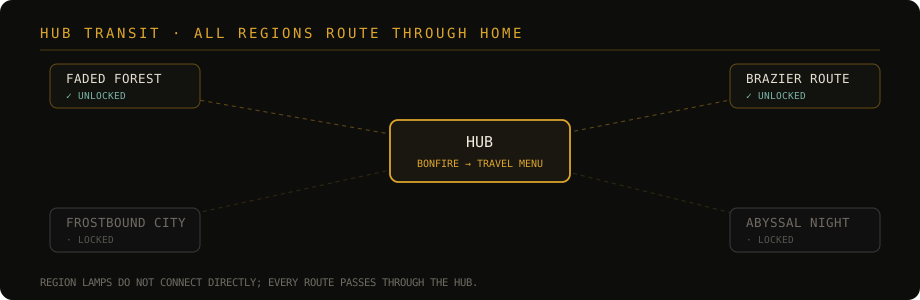
Regions do not connect directly. Cross-region movement always passes through the hub: sit at a bonfire → open the travel menu → choose an unlocked regional lamp → travel. This reinforces the hub’s central role, as in Bloodborne, while avoiding one of the most complex problems in a side-scrolling world: joining the boundaries of large regions. Only movement inside each region remains continuous on foot.
The structure also supports the setting. The faded world is breaking apart; each region is an island of surviving reality separated by the void. The travel menu is therefore not only a utility but also a statement about the world.
Bonfires: save anchors and death return
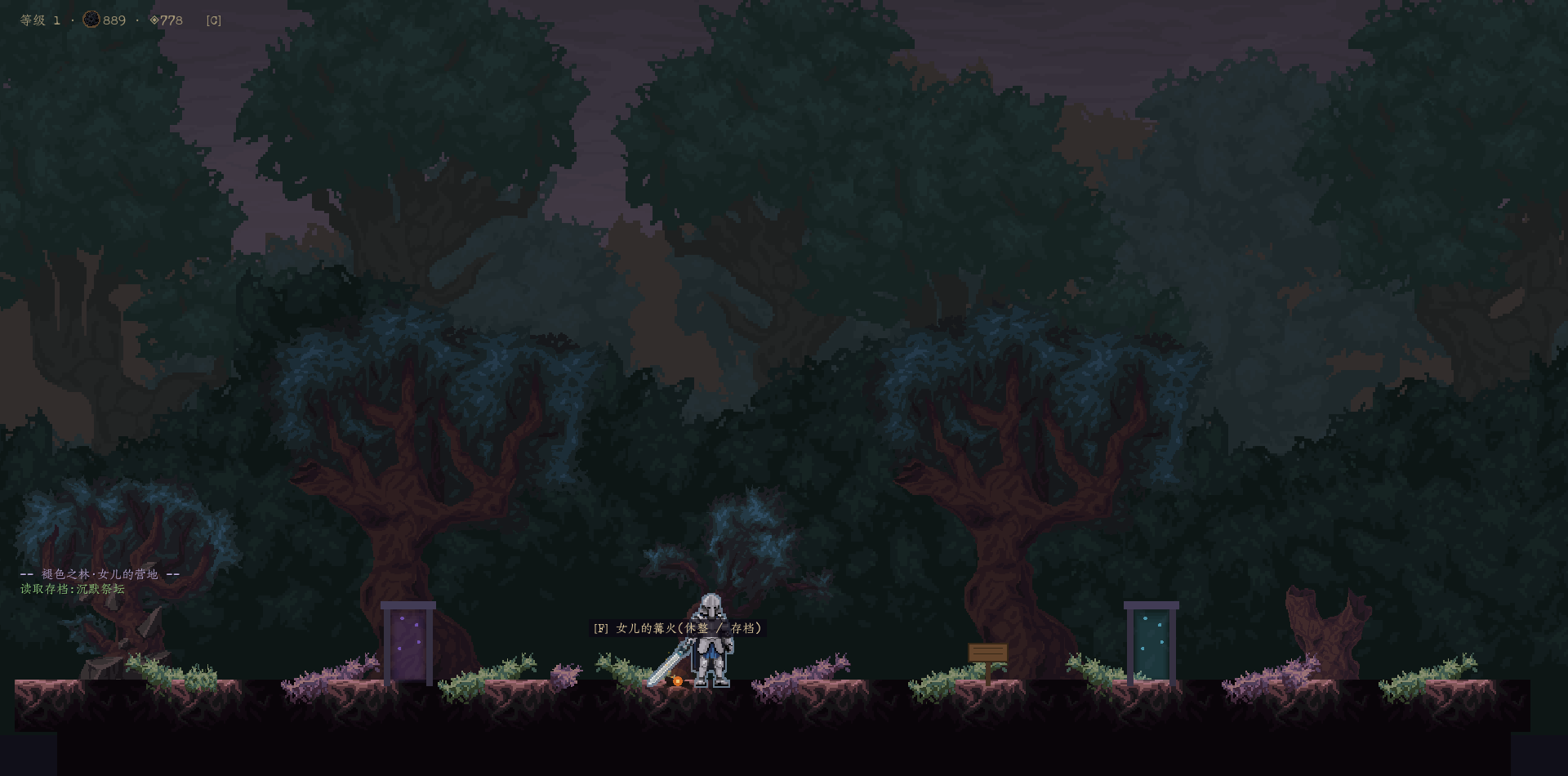
Bonfires provide rest, saving, and travel. After death, the player returns to the most recently activated bonfire. The image above shows the first bonfire in Chapter One, located in the daughter’s camp.
Death return expands gradually. Before the hub is unlocked, death always returns the player to the previous bonfire. After the hub is unlocked, the player chooses between the hub and the previous bonfire. The distance between bonfires establishes the game’s fundamental pacing interval.
Chapter One: a composed linear sequence
Chapter One is a deliberately composed linear route rather than an open world: awakening without dialogue and learning the basic systems → tutorial map → combat map → the smith’s daughter, with the first bonfire and a mandatory task to collect Lifefire for her father’s forge → Stone Giant boss, followed by a bonfire appearing in place → collapse from exhaustion and Vera’s entrance → the brazier sequence, where three braziers are lit → a predetermined-loss battle with Silas → fade to black and enter Chapter Two.
Two decisions are worth recording:
- Vera appears after the player collapses from exhaustion, not after the player is killed. This replaces the frustration of an unavoidable first death with the emotional premise of being helped back up;
- The predetermined-loss battle is numerically unwinnable, but the player does not drop Lifefire. It is a narrative transition rather than a normal combat challenge, and the fade to black leads directly into Chapter Two.
Summary: space as narrative
These elements form a single structure: a hub illuminated by story progress, measured distances between bonfires, isolated regional lamps, and a composed first chapter. The world layout becomes a physical expression of the theme of guarding the night.
Seamless interconnection is not a requirement for Soulslike spatial design. Pacing is the decisive factor, not the technical form.