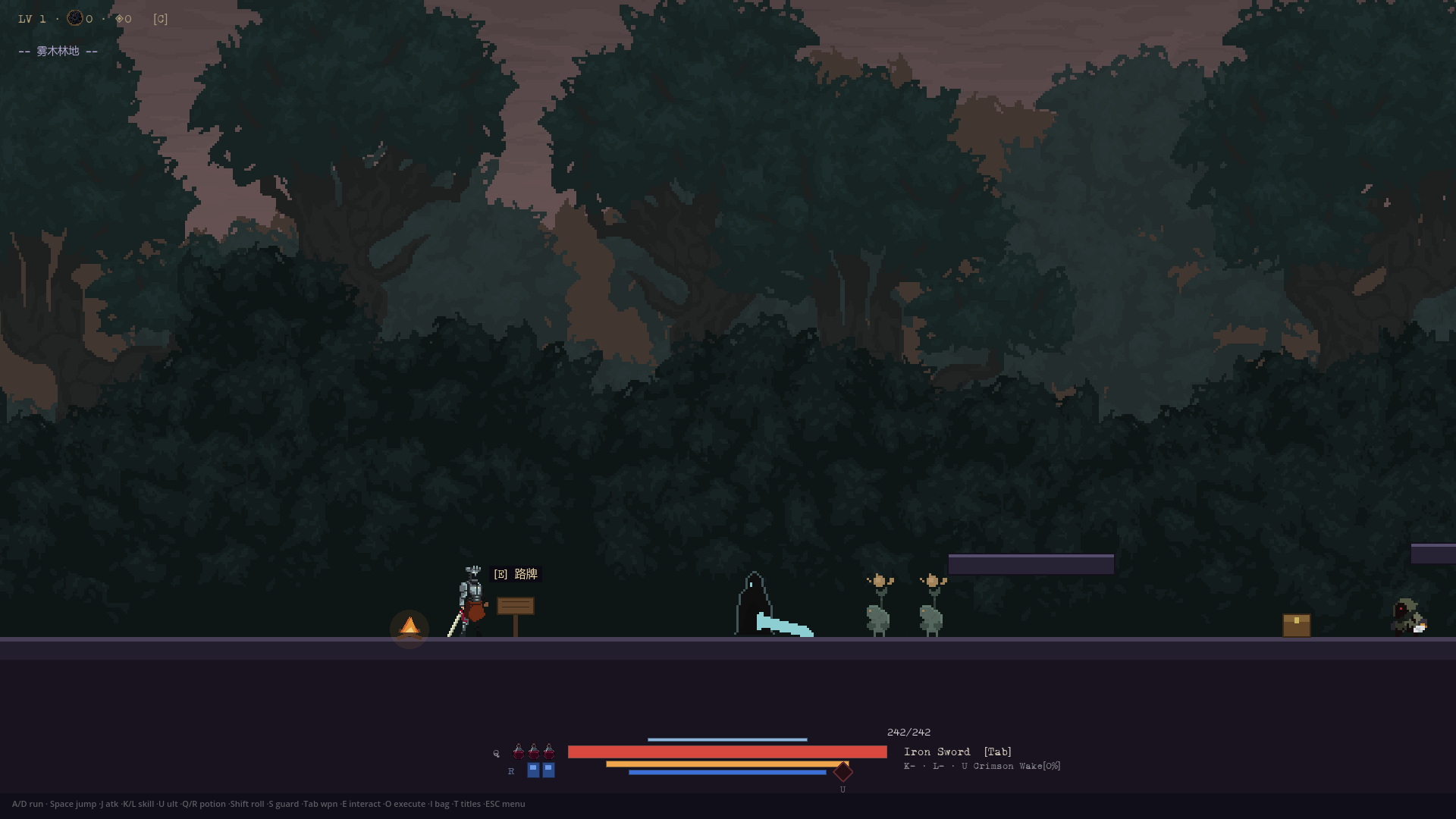
Developing a Soulslike independently requires simultaneous work on combat feel, levels, art, music, direction, and systems. Under ordinary conditions, that workload exceeds what one developer can sustain. Watchman does not address the problem by removing those areas. Instead, I changed my role: I moved from executing every task to directing the project, retained aesthetic and production decisions, and assigned verifiable work to AI-assisted production lines.
This first entry in the Watchman development notes records the project’s direction and its current solo-production model.
Project direction: keeping watch through an unending night
Watchman is a side-scrolling Soulslike with a dark, restrained direction and one iron sword carried through the full game. Grey is the world’s base colour; warmth appears only within the radius of a flame. The player guards the last source of light through an unending night. Bonfires define safe boundaries, while blocking, parrying, stance breaks, and executions structure close-range combat. The current target for a boss encounter is to end after two or three stance breaks.
Combat and world design will be documented separately in later entries. This article focuses on how production is organized.
Production model: one director and three AI production lines
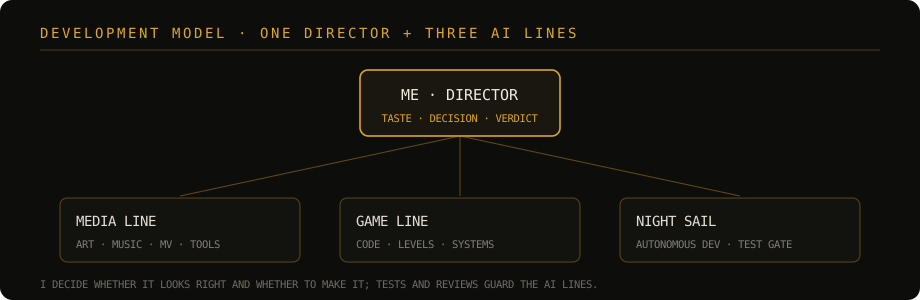
The current workflow is divided into three AI-assisted production lines, with me acting as director:
- Media line: art, music, music videos, and supporting production tools;
- Game line: code, levels, and system implementation;
- Night Sail: unattended development based on a written task brief, followed by testable results the next day. A separate article documents this workflow.
My two central responsibilities are to judge whether the work meets its intended direction and decide whether a proposal should enter production. Image selection, character approval, Vera’s facial design, and major system trade-offs remain my decisions. A machine can verify whether tests pass; whether the work itself is coherent still requires human judgment.
Conditions for delegation: test gates and adversarial review
The main risk in AI-assisted production is that a change may damage existing behaviour without being noticed. The delivery process therefore has two layers of control:
- Test gate: each delivery runs hundreds of assertions and cannot proceed unless all of them pass;
- Adversarial review: before integration, another AI reviews the proposal and implementation with the explicit goal of falsifying them. The change proceeds only when the review can no longer overturn it.
Together, these controls turn “able to run automatically” into “able to operate autonomously under controlled conditions.” Delegation depends on repeatable verification, not on general confidence in a model.
Scope of the following entries
Later articles will document the Night Sail workflow, the build system based on a single iron sword, the design of weight in Soulslike combat, bonfire and hub structure, and methods for tuning balance without changing code.
The series records practical methods and trade-offs in solo development with AI collaboration, one production problem at a time.